AI is everywhere right now.
Every company has a demo. Every product has a copilot. Every workflow has a wrapper. The noise is real.
But the real question is not: Can we connect an LLM to this interface?
The real question is: Can we deploy AI agents that actually work in production?
Why Context Is the Real Challenge
Because production is where things get hard.
Production means existing infrastructure. Existing tools. Existing habits. Existing constraints. Existing teams with their own ways of diagnosing, escalating, prioritizing, and making decisions.
You cannot solve that with a generic wrapper.
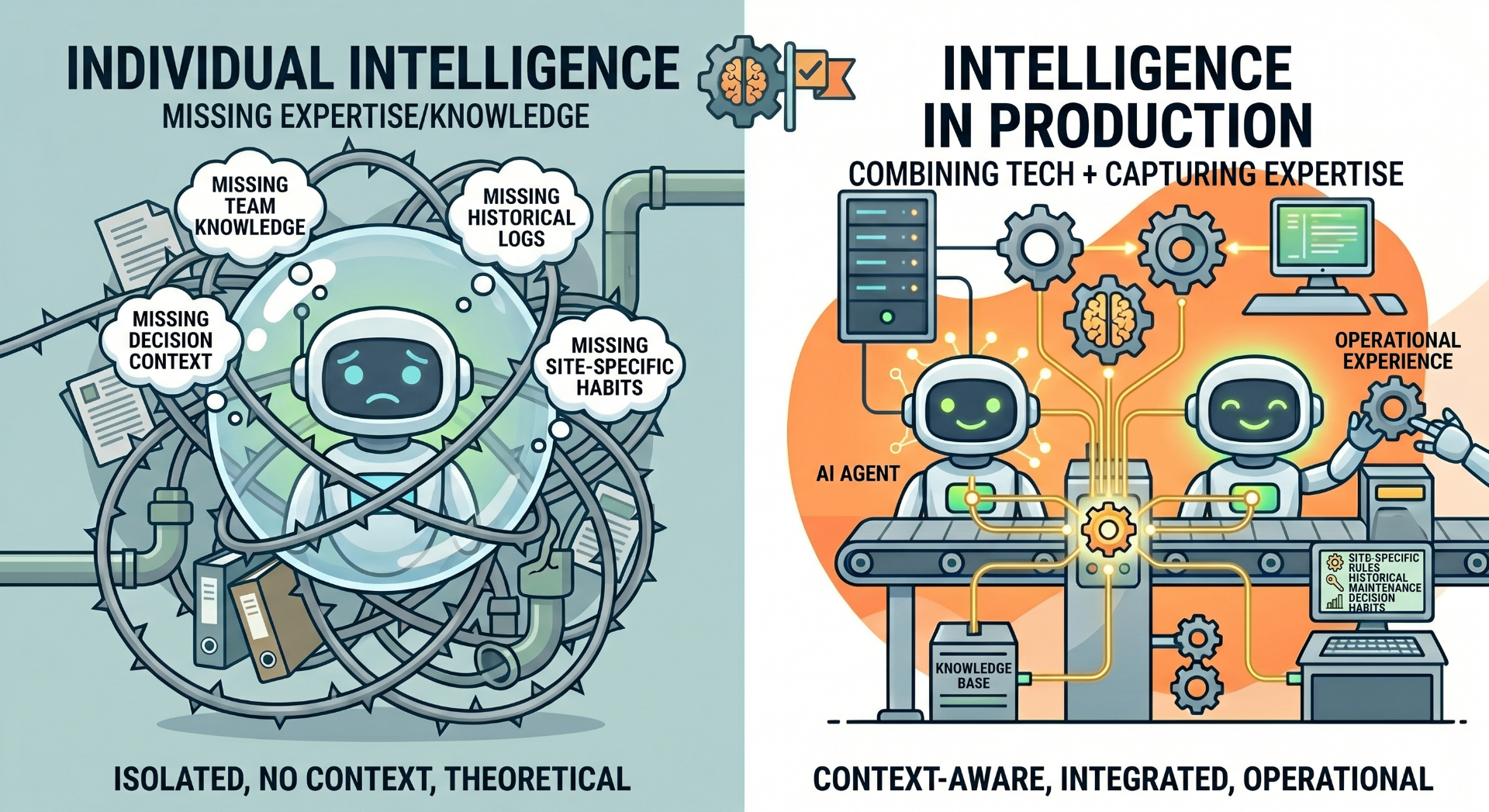
To make AI useful in the real world, you need more than a model. You need context.
Everyone worries about hallucinations. And they should. But in many operational environments, hallucinations are not only a model problem. They are often a symptom of missing context.
If the system has not been taught how a team defines a problem, interprets a signal, or decides what action matters, the AI has to guess.
And guessing is exactly what we do not want in production.
What an Anomaly Actually Means
Take anomaly detection in industrial operations.
It sounds simple: detect anomalies across a fleet of devices.
But what is an anomaly?
- Is it a value outside a statistical range?
- A deviation from historical behavior?
- A threshold defined by the manufacturer?
- A pattern that predicts failure?
- A condition that matters only during certain operating modes?
- A signal that is abnormal for one client, but perfectly acceptable for another?
The answer depends on the industry, the company, the equipment, the operating context, and sometimes even the habits of a specific team.
That is the point.
Intelligence, human or artificial, requires context.
A good technician does not only look at a number. They know the machine, the site, the weather, the maintenance history, the customer, the seasonality, the weird edge cases, and the things that are technically "normal" but operationally suspicious.
That knowledge is rarely fully written down.
It lives in tickets, spreadsheets, dashboards, manuals, conversations, Slack messages, maintenance logs, and people's heads.
How Production Agents Are Built
So if we want AI agents to work in production, we need to do two things equally well:
- Deploy advanced technology.
- Capture specific operational knowledge.
This is why Spocky relies as much on Forward Deployed Engineers as on AI.
The technology matters. But implementation is not just integration. It is translation.
Forward Deployed Engineers work close to the field. They learn how teams operate, what decisions they make, what signals they trust, what exceptions matter, and what "good" looks like in that specific environment.
Then that knowledge is turned into agents that can support real workflows.
Not generic agents.
Production agents.
- Agents that know what to check first.
- Agents that understand the difference between noise and risk.
- Agents that can explain why something matters.
- Agents that fit into how teams already work.
That is where AI becomes useful.
Not when it sounds impressive in a demo, but when it helps a busy team make a better decision on a Tuesday afternoon.
From Field Knowledge to Production
At Spocky, this methodology allows clients to put agents in production in three weeks.
Because the goal is not to build AI for AI's sake.
The goal is to make expertise available when and where it is needed.
AI will not transform operations because it can generate text. It will transform operations when it understands context, respects workflows, and helps people act faster with confidence.
The next phase of AI is not about who has the flashiest demo.
It is about who can make agents work in production.
Ready to deploy AI that actually works?
Turn your operational expertise into production agents that understand your context and fit into how your team already works.