Industrial Data Historians vs. Natural-Language Query Agents: What Changes on the Shop Floor
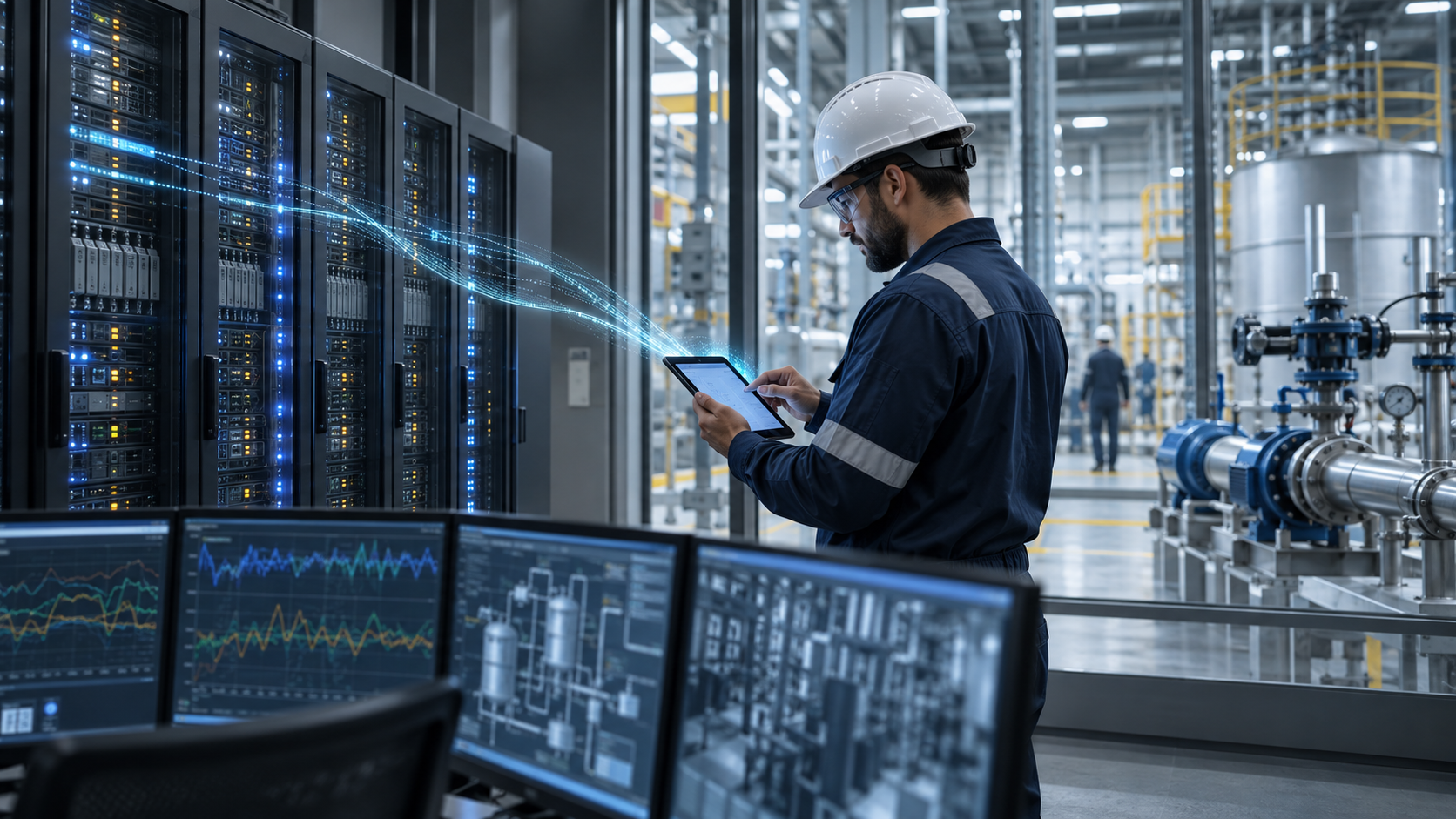
An industrial data historian stores the raw time-series memory of your plant, but someone still has to know how to query it. Here's what changes when a natural-language agent sits on top of PI, AVEVA, or FactoryTalk instead of replacing them.
"We have the data. We just can't get an answer fast enough."
That's the line we hear from O&M directors who already run a mature historian. PI, AVEVA, FactoryTalk — the raw data is there, timestamped and compressed, going back years.
The problem isn't collection. It's the gap between data sitting in the historian and a person getting an answer at the moment they need one.
This article is for the person comparing historian tools, not because they don't have one, but because they're asking whether their historian is enough on its own — or whether something needs to sit on top of it.
What a data historian actually does
An industrial data historian is a specialized database built to collect, store, and manage time-series data from industrial processes: temperature, pressure, flow, valve position, alarms, events, all timestamped for historical context.
According to AVEVA, its Historian product combines "advanced data storage and compression techniques with an industry-standard query interface" to give operations teams access to process, alarm, and event history for troubleshooting and decisions.
AspenTech describes the category the same way: a historian is "a meticulously organized digital archive" that captures every fluctuation and reading, and serves as the foundation for real-time monitoring, compliance reporting, and advanced analytics.
Historians are good at:
- High-speed, high-fidelity collection of raw time-series data
- Compression and long-term storage without blowing up conventional databases
- Data integrity across low-bandwidth links, late-arriving values, and mismatched clocks
- A query interface for engineers who already know the tag structure
That last point is where the gap opens up. The query interface is built for someone who already knows what to ask, and how to ask it in the historian's own language.
SCADA, historian, and where the confusion starts
People searching this topic often land on "what is the difference between SCADA and historian" as a related question. The short version: SCADA controls and displays the process right now. The historian archives what SCADA saw so someone can look back later.
Both answer "what happened." Neither one, on their own, answers "why did it happen" or "has this happened before, and what fixed it last time" without a person manually pulling tags, building a trend, and cross-referencing a separate maintenance log.
The gap: raw data still needs a person to translate it
Here's the pain we hear most from O&M directors running historians at scale: fleet-wide performance stays invisible until a tenant or a customer discovers the problem first. If a tenant has to discover the problem, the team has already failed.
The historian recorded the data. Nobody was watching it in a way that surfaced the anomaly to the person who could act.
A related pain: a single question like "why did pump B7 trip last Tuesday" turns into days of emails and Slack messages across three teams before anyone gets an answer, even though the historian has every data point needed to answer it in seconds. We wrote about that exact investigation loop in why your pump trip investigation takes 11 days.
The historian isn't the bottleneck. The bottleneck is that someone still has to know the tag names, build the right query, and remember which maintenance log to check.
What a natural-language query agent adds
A query agent doesn't replace the historian. It sits on top of it, as a reasoning layer that reads raw time-series data the way an experienced engineer would, and answers in plain language.
That's the model Spocky uses. Spocky doesn't re-ingest a historian's raw history into an LLM — at industrial scale that burns tokens and blows past context windows fast, something we go into in why re-ingesting time-series data into an LLM fails at industrial scale. Instead, Spocky's compute-down architecture sends the math to the data, wherever it already lives, and returns a deterministic, explainable answer.
Concretely, on top of an existing historian, that looks like:
- Ask — someone types "why did pump B7 trip last Tuesday" in plain English, no tag names required.
- Cross-reference — the agent pulls the relevant time-series window and automatically checks it against maintenance logs, work orders, and prior interventions.
- Answer — a deterministic, explainable result comes back in seconds, not after an 11-day email chain.
- Escalate to a person — if the finding calls for action on the fleet, a person signs off before anything changes.
The agent doesn't guess. It reasons across raw time-series data already sitting in the historian and shows its work.
Why this matters for O&M directors specifically
Three pains show up over and over for heads of operations running distributed fleets on top of a historian:
Fleet visibility. Waiting for a tenant to report a problem means the team already lost. A query and alerting layer that watches the fleet and flags anomalies as they appear — instead of leaving them buried in raw data — closes that gap.
Reactive truck rolls. Dispatching a technician before knowing whether a visit is even necessary erodes margin on every service contract. When telemetry, history, manuals, and past interventions are queryable in one place, more issues get resolved remotely, and the visits that remain happen with the right part in hand.
No proof an intervention worked. Comparing performance across sites and fleets, or confirming a fix actually held, usually means chasing dashboards after the fact. A query agent that cross-references intervention data automatically replaces that manual chase with a direct answer.
None of this requires switching historians. It requires a layer that makes the historian's data usable by the people making decisions, not just by the data team that knows how to query it.
What doesn't change
Your historian stays your system of record. PI stays PI. AVEVA stays AVEVA. The compression, the audit trail, the compliance reporting — that infrastructure doesn't go anywhere, and it shouldn't.
What changes is who can get an answer from it, and how fast. Instead of the data team fielding every ad hoc request, operators and engineers ask directly. Instead of a person acting alone on a fleet-wide change, the agent surfaces the finding and a person still signs off before action is taken.
Related reading on where this pattern shows up in predictive maintenance programs: predictive maintenance IoT programs fail without this one missing layer.
FAQ
What does a data historian do?
A data historian collects, stores, and manages time-series data from industrial processes — temperature, pressure, flow, alarms, and events — timestamped for later retrieval and analysis. It's the archive layer of a plant's control system, distinct from SCADA, which handles real-time control and display.
What is the difference between SCADA and a historian?
SCADA monitors and controls the process in real time. The historian archives what SCADA recorded so someone can look back later, build trends, or investigate an event after the fact.
Does adding a query agent mean replacing our historian?
No. A natural-language query agent like Spocky sits on top of your existing historian (PI, AVEVA, FactoryTalk, or others) as a reasoning layer. It reads the raw time-series data already stored there and answers questions in plain language, cross-referenced with maintenance logs and other operational context.
Can operators query the historian directly without the data team?
With a natural-language layer, yes. Operators and engineers ask questions in plain English and get a deterministic, explainable answer, without needing to know tag structures or query syntax. That frees the data team from being the bottleneck for every ad hoc request.
Does the agent take action on the fleet automatically?
No. Spocky surfaces findings and supports actions, but a person signs off before anything happens on the fleet. Human decision-making stays in the loop for any consequential action.