IoT Sensors Alone Won't Give You Predictive Maintenance, Here's What's Missing
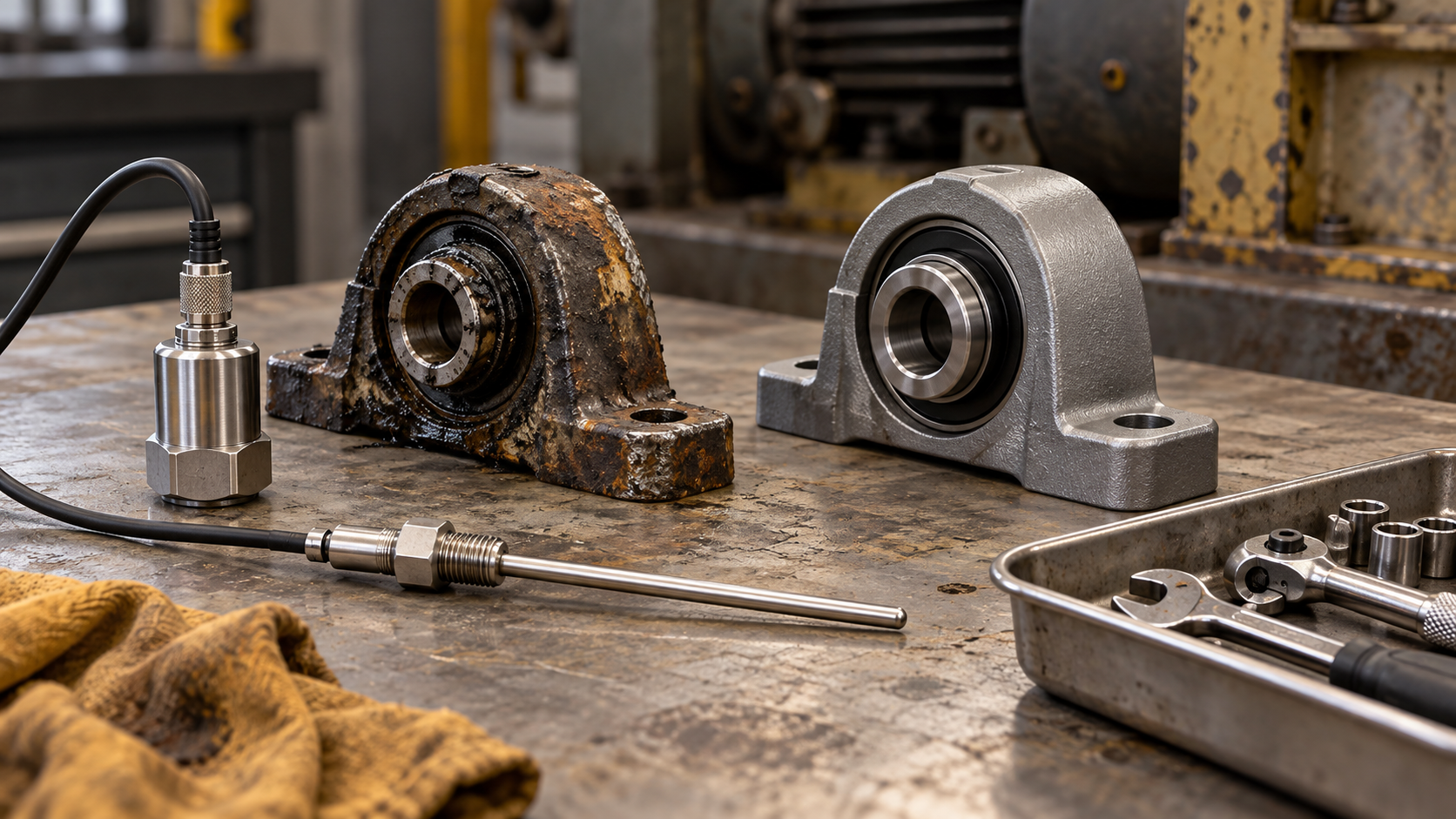
Sensors give you more raw data than ever, but data isn't the same as an answer. Here's why IoT sensors for predictive maintenance stall out without a layer that connects context, history, and tribal knowledge.
"We have sensors on everything. We still can't answer basic questions."
That's what an Industrial Data Lead told us, standing in front of a dashboard tracking thousands of tags across a fleet of machines.
The sensors were working. Vibration, temperature, pressure, current draw, all streaming in, all logged, all technically "available." And yet, when a pump tripped, nobody could say why without opening five systems and pinging three teams.
This is the gap that most content about IoT sensors for predictive maintenance skips over. It talks about sensor types, thresholds, and dashboards. It rarely mentions what happens after the sensor sends its reading, which is where predictive maintenance actually lives or dies.
Sensors don't predict anything. They measure. Turning a measurement into a decision requires context that no sensor captures: the work order tied to the last repair, the technician's note about what actually fixed it last time, the maintenance log buried in a different system entirely.
What IoT sensors for predictive maintenance actually do, and don't do
IoT predictive maintenance, at its core, is a maintenance strategy that uses connected sensors to gather and analyze equipment data so problems surface before they cause downtime (AspenTech). Sensors and monitors are placed on or built into equipment to track variables, vibration, temperature, pressure, that indicate wear or failure risk, and that data feeds into software meant to catch issues early (AspenTech).
That's the pitch. It's also where most explanations of IoT predictive maintenance stop.
What they leave out: the sensor's job ends the moment the reading is transmitted. Everything that matters next, is this reading normal for this machine, has this pattern happened before, did the last intervention actually work, who needs to know right now, depends on context the sensor never had.
A vibration spike means one thing on a pump that was serviced last week and something else entirely on one that's been running clean for a year. The sensor can't tell the difference. Only the combined record of work orders, maintenance logs, and the technician's tribal knowledge can.
The loop that raw sensor data can't complete on its own
Here's the operating loop a maintenance question actually has to move through, and where sensor-only setups break down at each step:
- Detect, A sensor logs an anomalous reading. This part works. It's the one thing sensor vendors are good at.
- Contextualize, Is this reading unusual for this specific asset, at this specific point in its life? This requires cross-referencing history, not just the live feed.
- Investigate, Why is it happening? This means pulling maintenance logs, prior work orders, and often calling someone who remembers what happened last time.
- Decide, Does this warrant a technician, a schedule change, or nothing? Someone has to weigh the anomaly against operational priorities.
- Act and document, The intervention happens, and, if the team is disciplined, gets logged somewhere for next time.
Most sensor deployments give you step 1 and stop. Steps 2 through 5 happen in someone's head, in a spreadsheet, or across a chain of emails and Slack messages that can stretch for days. We've written about exactly what an IoT predictive maintenance case study leaves out, the 11-day investigation that happens before any model or dashboard ever gets credit for an answer.
The pain shows up as a single, blunt question: "why did pump B7 trip last Tuesday?" And instead of an answer, it triggers a chain of emails across three teams that can take over a week to resolve, not because the data doesn't exist, but because nothing connects it.
Why more sensors don't fix the problem
The instinct, when predictive maintenance doesn't deliver, is often to add more sensors. More tags, more granularity, more coverage.
But 95% of raw industrial data already goes untapped, not because there isn't enough of it, but because only the data team knows how to query it. Every operational question routes through the same bottleneck. Adding sensors adds more untapped data, it doesn't add more people who can use it.
There's also a harder technical wall. Re-ingesting billions of raw time-series points into a language model to ask a simple question burns tokens fast and blows past context windows. One heat pump, over one week, can generate 5 to 30 times the data of the largest context window on the market. You cannot brute-force your way to an answer by shipping more raw sensor data into a model that wasn't built to hold it. We go deeper on why that approach fails at scale in why re-ingesting time-series data into an LLM fails at industrial scale.
The fix isn't fewer or more sensors. It's a layer that sends the question to the data instead of the data to the question.
What's actually missing: context, not more data
Work orders live in one system. Machine data lives in another. Quality findings are on paper. Maintenance know-how is in the technician's head. By the time anyone connects all four, the next production run has already started.
This is the layer that most IoT predictive maintenance content never mentions, because it isn't a sensor problem, it's a context problem. Closing it means:
- Following one thread from work order through quality control to maintenance, instead of four disconnected records.
- Cross-referencing a live anomaly against maintenance logs automatically, not manually.
- Making that cross-referenced answer available in seconds, not after an email chain.
This is also why monitoring alone isn't the same as investigation. An alarm tells you what happened. Finding out why requires searching history, comparing past events, and testing explanations, a different job entirely. We cover that distinction in monitoring tells you what happened, here's what it takes to find out why.
And it's why the difference between preventive and predictive maintenance matters more than the label. Preventive maintenance runs on a schedule. Predictive maintenance requires an actual read on current condition versus history, which is exactly the context layer sensors alone don't provide. More on that distinction in predictive maintenance vs. preventive maintenance.
How Spocky closes the loop sensors leave open
Spocky doesn't replace sensors. It's the layer that sits on top of them and makes the raw data usable at the moment someone needs it.
The architecture is compute-down: instead of shipping billions of raw time-series points into a context window, Spocky sends the math to the data. That keeps latency and token use down and keeps answers deterministic and explainable, not sampled, not approximate.
Deployment starts with Forward Deployed Engineers who spend time with operators capturing the context a sensor never records: which work orders map to which failures, what the technician actually does when an alarm fires, which fixes hold and which don't. That context gets built into customized agents, deployed into production in about three weeks.
Once live, the agent works the loop end to end:
- Logic-check and alerting agents flag an anomaly to the shop manager and quality lead the moment it appears, instead of it sitting in raw data.
- Ask Spocky turns "why did pump B7 trip last Tuesday" into a deterministic, explainable answer in seconds, cross-referenced automatically against maintenance logs.
- One launch-interface entry creates a single thread from work order through quality control to maintenance, closing the loop for the next run.
- Natural-language query lets operators ask questions directly, without needing the data team to write it for them, freeing that team from being the bottleneck for every ad hoc request.
This is the same reasoning we lay out in the real bottleneck in industrial IoT predictive maintenance isn't the sensors, it's the questions you haven't asked yet and in why predictive maintenance pilots stall before they ever reach prediction: exploration and context come before prediction, not after it.
A person still signs off before any action touches the fleet. Spocky's agents surface the answer and the evidence behind it, they don't act on their own.
What changes when sensors have a reasoning layer behind them
With sensors alone: an anomaly sits in raw data until someone happens to notice it. A question about a trip becomes an email chain. The data team fields the same ad hoc request every week.
With sensors plus context: the anomaly reaches the right person the moment it appears. The trip question gets a deterministic, explainable answer in seconds, backed by maintenance history. Operators query the data directly, in plain language, without waiting on the data team.
The sensors were never the missing piece. The missing piece was always what happens to their data after it's collected.
FAQ
What types of sensors are commonly used in predictive maintenance?
Common sensors track vibration, temperature, pressure, current draw, and acoustic signals on rotating and process equipment. These sensors generate the raw time-series data that a predictive maintenance program depends on, but the sensor itself only measures, it doesn't determine whether a reading is normal, urgent, or tied to a known failure pattern. That step requires context from work orders, maintenance logs, and operator knowledge.
How can IoT technology be used for predictive maintenance?
IoT sensors collect equipment data in real time and transmit it to software that looks for signs of developing failure, letting teams act before a breakdown instead of after (AspenTech). In practice, this only works end to end when the raw sensor data is connected to maintenance history and operational context, otherwise, anomalies get logged but never reach the person who needs to act on them.
Why doesn't adding more sensors solve the predictive maintenance data problem?
More sensors mean more raw data, not more people who can use it. In most industrial teams, the vast majority of raw data goes unqueried because only the data team knows how to access it. Adding sensor coverage without adding a way to query and contextualize that data just grows the backlog.
Can you just feed sensor data into an LLM to get predictive answers?
Not at industrial scale. A single asset's raw time-series data over one week can be many times larger than the biggest context window available today, so re-ingesting it into a language model burns tokens and adds latency without producing a reliable answer. An architecture that sends the query to the data, instead of the data to the query, avoids that bottleneck.
What's the difference between monitoring and predictive maintenance?
Monitoring tells you what happened, an alarm fires when a threshold is crossed. Predictive maintenance requires understanding why it happened and whether it's likely to recur, which means comparing current readings against history, work orders, and past interventions, not just watching a live feed.